Pearson Edexcel · GCSE · Psychology
Course version: 1PS0 · Version from Sept 2017
Understand two treatments to rehabilitate and reduce criminal and…
Full specification wording
Criminal psychology: 6.1.4 Understand two treatments to rehabilitate and reduce criminal and antisocial behaviour and increase pro-social behaviour, including strengths and weaknesses of each treatment: a. token economy programmes b. anger-management programmes
Rehabilitation aims to reduce criminal and antisocial behaviour while increasing pro-social behaviour.
Checked against the Pearson Edexcel 1PS0 specification (opens in a new tab) on .
- Point 4 of 4
- 4 key terms
Study notes
From the checked teaching notes for this specification point.
The idea
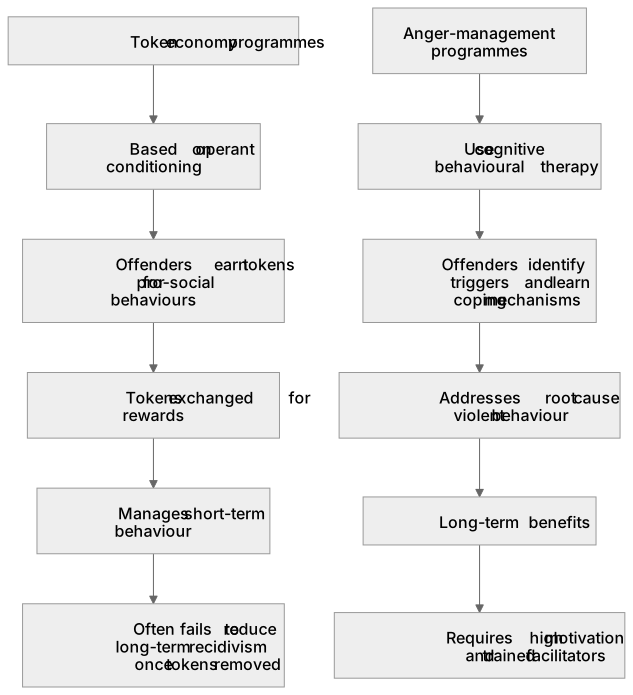
Rehabilitation aims to reduce criminal and antisocial behaviour while increasing pro-social behaviour. Token economy programmes use operant conditioning in institutions like prisons. Offenders earn tokens for pro-social behaviours (e.g. following rules), which are exchanged for rewards (e.g. extra phone time). This effectively manages short-term behaviour but often fails to reduce long-term recidivism once tokens are removed. Anger-management programmes use cognitive behavioural therapy to help offenders identify triggers and learn coping mechanisms (e.g. deep breathing) to control aggressive impulses. This addresses the root cause of violent behaviour, offering long-term benefits, but requires high motivation and trained facilitators.
What earns the marks
- Explain that token economies are based on operant conditioning, using secondary reinforcers (tokens) to reward pro-social behaviour.
- Identify that token economies are effective for institutional management but lack long-term effectiveness outside the institution.
- Describe anger-management programmes as a cognitive behavioural approach that teaches offenders to recognise and manage anger triggers.
- Evaluate anger management by noting it addresses underlying cognitive causes of antisocial behaviour, potentially reducing long-term recidivism.
- Contrast the two treatments by highlighting that token economies focus on observable behaviour, while anger management focuses on internal cognitive processes.
Common mistakes and how to put them right
Stating that tokens in a token economy are the actual reward.
Put it right: Clarify that tokens are secondary reinforcers that must be exchanged for primary rewards or privileges.
Assuming anger management is suitable for all offenders.
Put it right: Note that anger management is only effective for offenders whose crimes are motivated by anger, not for instrumental or calculated crimes.
Claiming token economies change the underlying causes of criminal behaviour.
Put it right: Explain that token economies only modify surface behaviour through reinforcement and do not address cognitive or emotional causes.
Exam tips
- Clearly distinguish between antisocial behaviour (actions that harm or lack consideration for others) and pro-social behaviour (actions that benefit others).
- When discussing token economies, explicitly use psychological terminology such as operant conditioning, positive reinforcement, and secondary reinforcers.
- Evaluate treatments by comparing their short-term effectiveness in institutions against their long-term success in reducing recidivism in society.
Try the lesson
The start of the Criminal psychology: 6.1.4 Understand two treatments to rehabilitate and reduce criminal and antisocial behaviour and increase pro-social behaviour, including strengths and weaknesses of each treatment: a. token economy programmes b. anger-management programmes lesson, made from checked teaching notes for this specification point.
Have a go first
How does a token economy programme aim to increase pro-social behaviour in a prison setting?
Listen
Rehabilitation aims to reduce criminal and antisocial behaviour while increasing pro-social behaviour. Token economy programmes use operant conditioning in institutions like prisons. Offenders earn tokens for pro-social behaviours (e.g. following rules), which are exchanged for rewards (e.g. extra phone time). This effectively manages short-term behaviour but often fails to reduce long-term recidivism once tokens are removed. Anger-management programmes use cognitive behavioural therapy to help offenders identify triggers and learn coping mechanisms (e.g. deep breathing) to control aggressive impulses. This addresses the root cause of violent behaviour, offering long-term benefits, but requires high motivation and trained facilitators. A strong answer earns marks for these points. Explain that token economies are based on operant conditioning, using secondary reinforcers (tokens) to reward pro-social behaviour. Identify that token economies are effective for institutional management but lack long-term effectiveness outside the institution. Describe anger-management programmes as a cognitive behavioural approach that teaches offenders to recognise and manage anger triggers. Evaluate anger management by noting it addresses underlying cognitive causes of antisocial behaviour, potentially reducing long-term recidivism. A common slip: Stating that tokens in a token economy are the actual reward. Instead, Clarify that tokens are secondary reinforcers that must be exchanged for primary rewards or privileges. Exam tip: Clearly distinguish between antisocial behaviour (actions that harm or lack consideration for others) and pro-social behaviour (actions that benefit others).
See it
Key words
Say what each word means before you turn the card.
Rehabilitation
Try answering aloud or in your head before turning the card.
Token economy programmes
Try answering aloud or in your head before turning the card.
Anger-management programmes
Try answering aloud or in your head before turning the card.
Pro-social behaviour
Try answering aloud or in your head before turning the card.
See every definition
- Rehabilitation
- Aims to reduce criminal and antisocial behaviour while increasing pro-social behaviour.
- Token economy programmes
- Use operant conditioning in institutions like prisons, where offenders earn tokens for pro-social behaviours that are exchanged for rewards.
- Anger-management programmes
- Use cognitive behavioural therapy to help offenders identify triggers and learn coping mechanisms to control aggressive impulses.
- Pro-social behaviour
- Actions that benefit others, which rehabilitation aims to increase.
Label the diagram
Some boxes have lost their names. Pick the right name for each number.
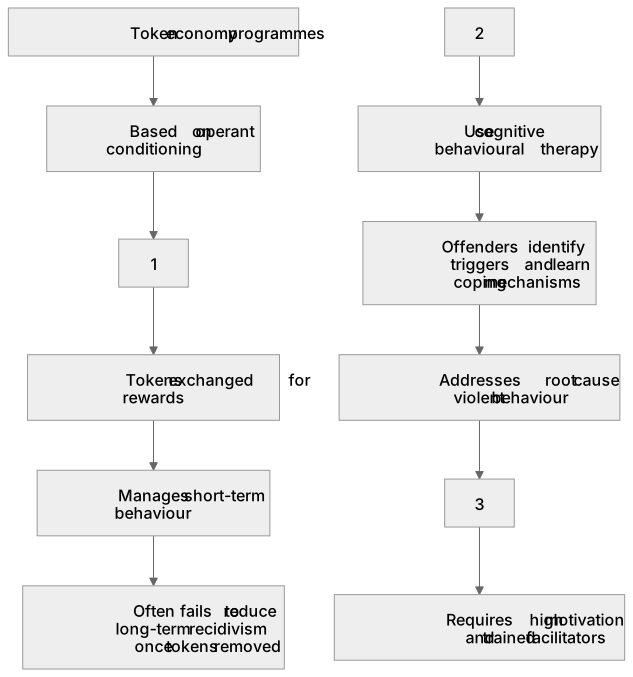
1Box 1
2Box 2
3Box 3
There is more to this lesson
The full lesson goes on to check your understanding and help you earn the marks. Create a free account to carry on, with your progress saved.
A week of Premium from your first lesson · Then the free plan continues · No card, no charge
Test your understanding of Criminal psychology: 6.1.4 Understand two treatments to rehabilitate and reduce criminal and antisocial behaviour and increase pro-social behaviour, including strengths and weaknesses of each treatment: a. token economy programmes b. anger-management programmes
Active recall beats re-reading. Take an instant quiz now to test what you’ve learned and lock it into long-term memory.
A week of Premium from your first lesson · Then the free plan continues · No card, no charge